
A year of 15-minute electricity prices – what was it worth? Price control saves, quarter-hours add only a few euros
In October 2025 the spot price started changing every 15 minutes. We compared what quarter-hour prices meant over a year in 21 European price zones: heating a family of four's hot water at the cheapest times instead of on a night timer saved 38–316 €, but picking quarter-hours instead of whole hours added only 2–13 €.
A year of 15-minute electricity prices – what was it worth? Price control saves, quarter-hours add only a few euros
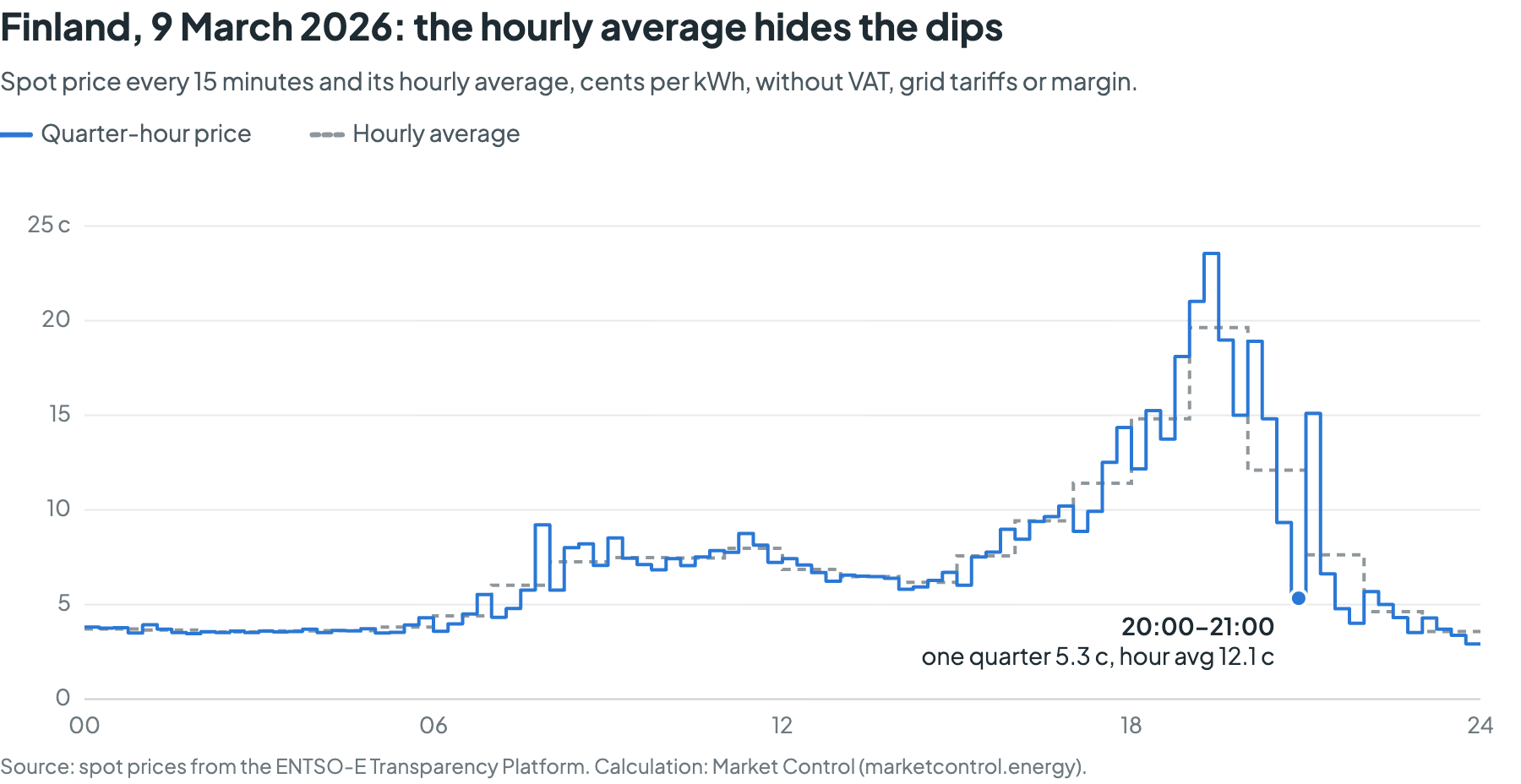
Since 1 October 2025, the European spot price of electricity has been set for every quarter-hour instead of every hour. At its most extreme, the price in Finland moved 30.8 cents per kWh within a single hour: on 3 February 2026 the quarters of 06:00–07:00 cost 17.8, 25.0, 40.0 and 48.6 cents. On average, though, the four quarters of an hour differed by only 1.6 cents, and in more than half of all hours by less than one cent.
Price control paid off. Heating a family of four's hot water in the cheapest part of the day, instead of on a night timer from 22:00, saved 38–316 € a year across the 21 European price zones we measured, 19–73 % of the hot water's spot-price cost (Finland 88 € or 43 %, Germany 315 € or 63 %, from October 2025 to September 2026). In Finland that is about 110 € with VAT, roughly 18 % of the hot water's whole electricity bill once grid fees, taxes and margin are included. The quarter-hours themselves added little extra saving: picking the cheapest quarter-hours instead of the cheapest whole hours was worth only 2–13 € a year, or 1–6 % (Finland and Germany 6 €). The year mattered far more than the resolution: in the last year of hourly prices, the same control saved 8–248 €.
This article explains what changed, where the quarter-hour does and does not matter, how this year compared with the last one, and how much price control actually saves. All figures are computed from a full year of actual spot prices, quarter-hour by quarter-hour (hour by hour for the previous year), and the method is at the end.
What changed on 1 October 2025?
Europe's day-ahead market, where the next day's wholesale price is set every afternoon, moved from 24 prices a day to 96. The first quarter-hour auction ran on 30 September 2025 for delivery on 1 October, in all European bidding zones at once (APG).
Nothing else about the market changed. Prices for the next day are still published around 13:00 CET, and they are still the wholesale price only, before VAT, grid tariffs and your retailer's margin. What changed is the resolution: the four quarters of an hour can now have four different prices.
Does an hourly price still mean anything?
An hourly price is now the average of four quarter-hour prices. Most of the time that average is close to the truth, because prices move slowly at night and around midday. Around the morning and evening ramps, when demand, solar output and cross-border flows shift quickly, the four quarters can be far apart.
How much does the price move within an hour?
Across the 21 zones we measured, the price swung by up to 15–67 cents per kWh within a single hour, depending on the zone. The biggest swings came in the Baltic states on 7 October 2025. On average, though, the four quarters of an hour differed by only 0.6–3.0 cents, and in 30–85 % of hours by less than one cent. Prices move most in the Baltic states and least in Norway.
| Zone | Largest swing within an hour | Average swing within an hour | Swing under one cent (% of hours) | Cheapest quarter not in cheapest hour |
|---|---|---|---|---|
| FI | 30.8 c | 1.6 c | 57 % | 46 % |
| SE1 | 15.4 c | 1.1 c | 67 % | 51 % |
| SE2 | 16.3 c | 1.1 c | 66 % | 52 % |
| SE3 | 23.8 c | 1.5 c | 55 % | 53 % |
| SE4 | 36.4 c | 1.9 c | 50 % | 52 % |
| NO1 | 15.3 c | 0.8 c | 76 % | 39 % |
| NO2 | 19.4 c | 0.9 c | 72 % | 41 % |
| NO3 | 16.7 c | 0.9 c | 72 % | 44 % |
| NO4 | 17.0 c | 0.7 c | 80 % | 38 % |
| NO5 | 15.2 c | 0.6 c | 85 % | 34 % |
| DK1 | 48.3 c | 2.1 c | 43 % | 55 % |
| DK2 | 55.9 c | 2.3 c | 41 % | 56 % |
| EE | 67.2 c | 2.7 c | 43 % | 52 % |
| LV | 65.1 c | 3.0 c | 39 % | 56 % |
| LT | 65.1 c | 3.0 c | 38 % | 55 % |
| DE | 46.0 c | 2.4 c | 37 % | 48 % |
| NL | 54.9 c | 2.5 c | 36 % | 48 % |
| BE | 62.6 c | 2.4 c | 35 % | 50 % |
| FR | 33.3 c | 2.2 c | 35 % | 51 % |
| AT | 40.2 c | 2.8 c | 30 % | 56 % |
| PL | 41.7 c | 2.6 c | 34 % | 52 % |
Cents per kWh, spot price only, October 2025 to September 2026. The swing within an hour is the gap between the hour's dearest and cheapest quarter. The last column is the share of days on which the single cheapest quarter-hour fell outside the cheapest whole hour.
Is the cheapest quarter-hour ever in the most expensive hour?
Almost never. Across 365 days and 21 zones it happened only twice, both times in northern Norway (NO4) on a spring morning when the price fell steeply within a single hour. Quarter-hour prices have not got out of hand: the cheap part of the day is still cheap, and the expensive part still expensive.
What changes is the fine detail. On 34–56 % of days, depending on the zone, the cheapest quarter-hour was not in the cheapest hour. A control that picks whole hours still lands in the right part of the day, just not always on its best 15 minutes.
What is quarter-hour control worth for a family's hot water?
We costed the hot water of a family of four, heated by a 3 kW electric water heater, the usual element size for a 100–300 litre tank in Finland. The family uses about 12 kWh a day, tank losses included (about 4,400 kWh a year), so the heater runs 4 hours a day. This is hot water only, not space heating. We compared four controls:
- Cheapest 16 quarter-hours of each day, wherever they fall.
- Cheapest 4 whole hours by hourly average.
- Cheapest single 4-hour block, chosen at quarter-hour resolution, for a device that should run once a day.
- A fixed night timer from 22:00 to 02:00, the way a night-rate relay switches the water heater in many Finnish homes.
| Zone | Cheapest 16 quarter-hours | Cheapest 4 whole hours | Cheapest single 4 h block | Night timer from 22:00 | Price control vs timer | Quarter-hours vs whole hours |
|---|---|---|---|---|---|---|
| FI | 116 € | 121 € | 122 € | 203 € | 88 € (43 %) | 6 € (5 %) |
| SE1 | 92 € | 98 € | 98 € | 139 € | 46 € (33 %) | 5 € (5 %) |
| SE2 | 94 € | 99 € | 99 € | 141 € | 47 € (34 %) | 5 € (5 %) |
| SE3 | 150 € | 155 € | 155 € | 264 € | 114 € (43 %) | 5 € (3 %) |
| SE4 | 169 € | 174 € | 174 € | 347 € | 178 € (51 %) | 5 € (3 %) |
| NO1 | 296 € | 299 € | 300 € | 421 € | 125 € (30 %) | 3 € (1 %) |
| NO2 | 290 € | 293 € | 294 € | 449 € | 159 € (35 %) | 3 € (1 %) |
| NO3 | 237 € | 241 € | 243 € | 303 € | 66 € (22 %) | 4 € (2 %) |
| NO4 | 74 € | 77 € | 79 € | 112 € | 38 € (34 %) | 3 € (4 %) |
| NO5 | 328 € | 330 € | 332 € | 406 € | 77 € (19 %) | 2 € (1 %) |
| DK1 | 209 € | 214 € | 212 € | 482 € | 274 € (57 %) | 6 € (3 %) |
| DK2 | 213 € | 219 € | 217 € | 475 € | 262 € (55 %) | 6 € (3 %) |
| EE | 142 € | 149 € | 153 € | 320 € | 178 € (56 %) | 8 € (5 %) |
| LV | 178 € | 186 € | 188 € | 428 € | 250 € (59 %) | 9 € (5 %) |
| LT | 179 € | 188 € | 190 € | 430 € | 251 € (58 %) | 9 € (5 %) |
| DE | 187 € | 194 € | 191 € | 502 € | 315 € (63 %) | 6 € (3 %) |
| NL | 188 € | 195 € | 192 € | 504 € | 316 € (63 %) | 7 € (4 %) |
| BE | 197 € | 205 € | 202 € | 496 € | 300 € (60 %) | 8 € (4 %) |
| FR | 111 € | 118 € | 117 € | 417 € | 307 € (73 %) | 7 € (6 %) |
| AT | 252 € | 264 € | 260 € | 560 € | 308 € (55 %) | 13 € (5 %) |
| PL | 236 € | 244 € | 242 € | 529 € | 294 € (55 %) | 8 € (3 %) |
Spot-price cost of heating the water from October 2025 to September 2026, without VAT, grid tariffs or margin. "Price control vs timer" compares the cheapest 16 quarter-hours with the night timer. The percentages are the saving as a share of the night timer's and of hourly control's cost.
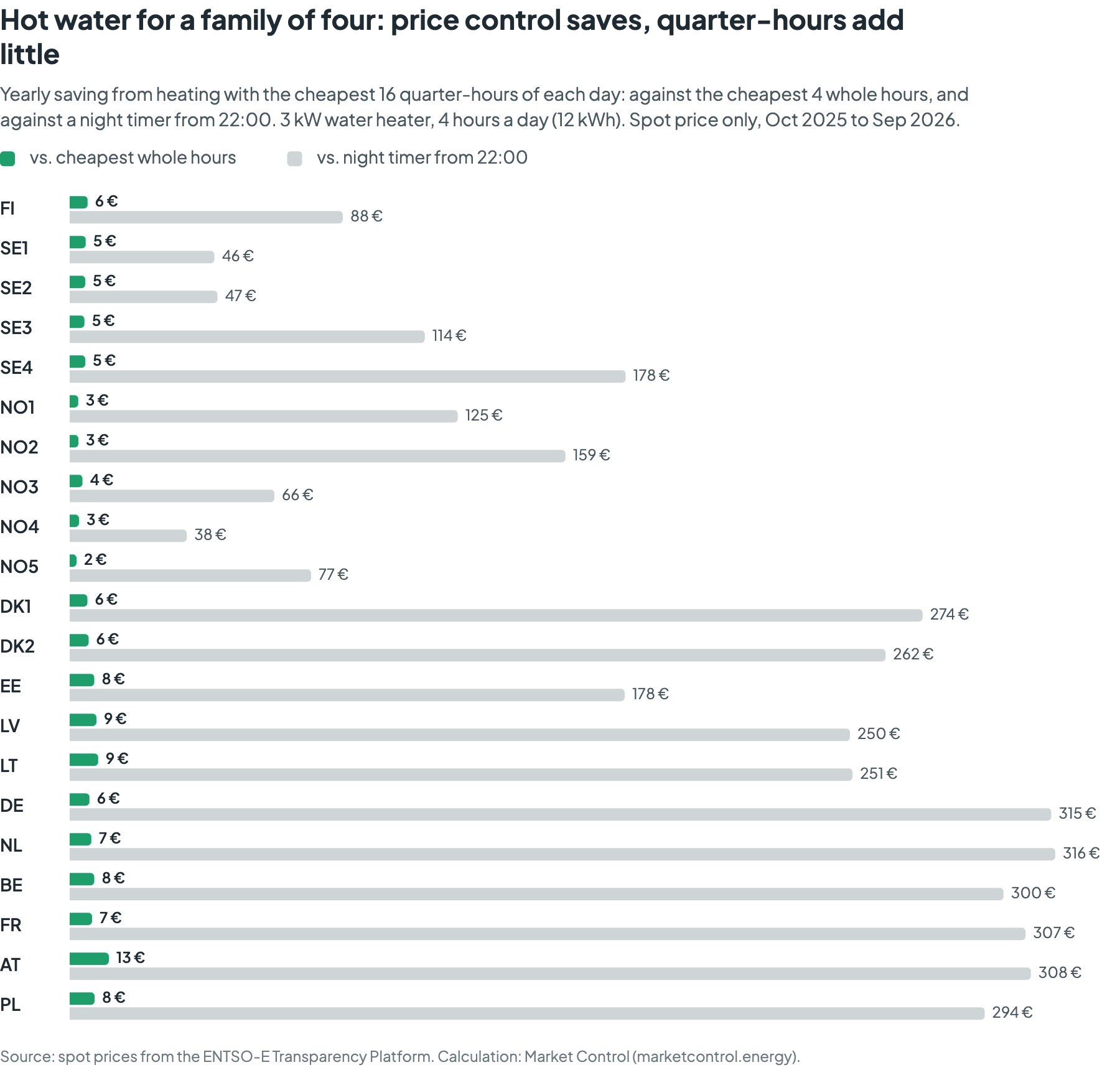
The pattern is the same in every zone. Price control instead of a night timer saved 38–316 € a year at spot price alone. Only 2–11 % of that, 2–13 €, came from the quarter-hours; picking the cheapest whole hours already gets the rest.
Should a device switch every 15 minutes?
Usually not. The cheapest 16 quarter-hours of a day came in 2.7–4.6 separate runs on average, so a heater chasing them switches on and off several times a day. The cheapest single 4-hour block cost only 3–12 € a year more than that, which made it about as cheap as the four cheapest whole hours.
A water heater behind a contactor copes fine with a few switchings a day. A heat pump compressor, or anything else with a minimum run time, should not be cycled every quarter-hour. For those, one or two well-placed blocks a day keep nearly all of the saving and spare the hardware.
Was price control worth more when prices were hourly?
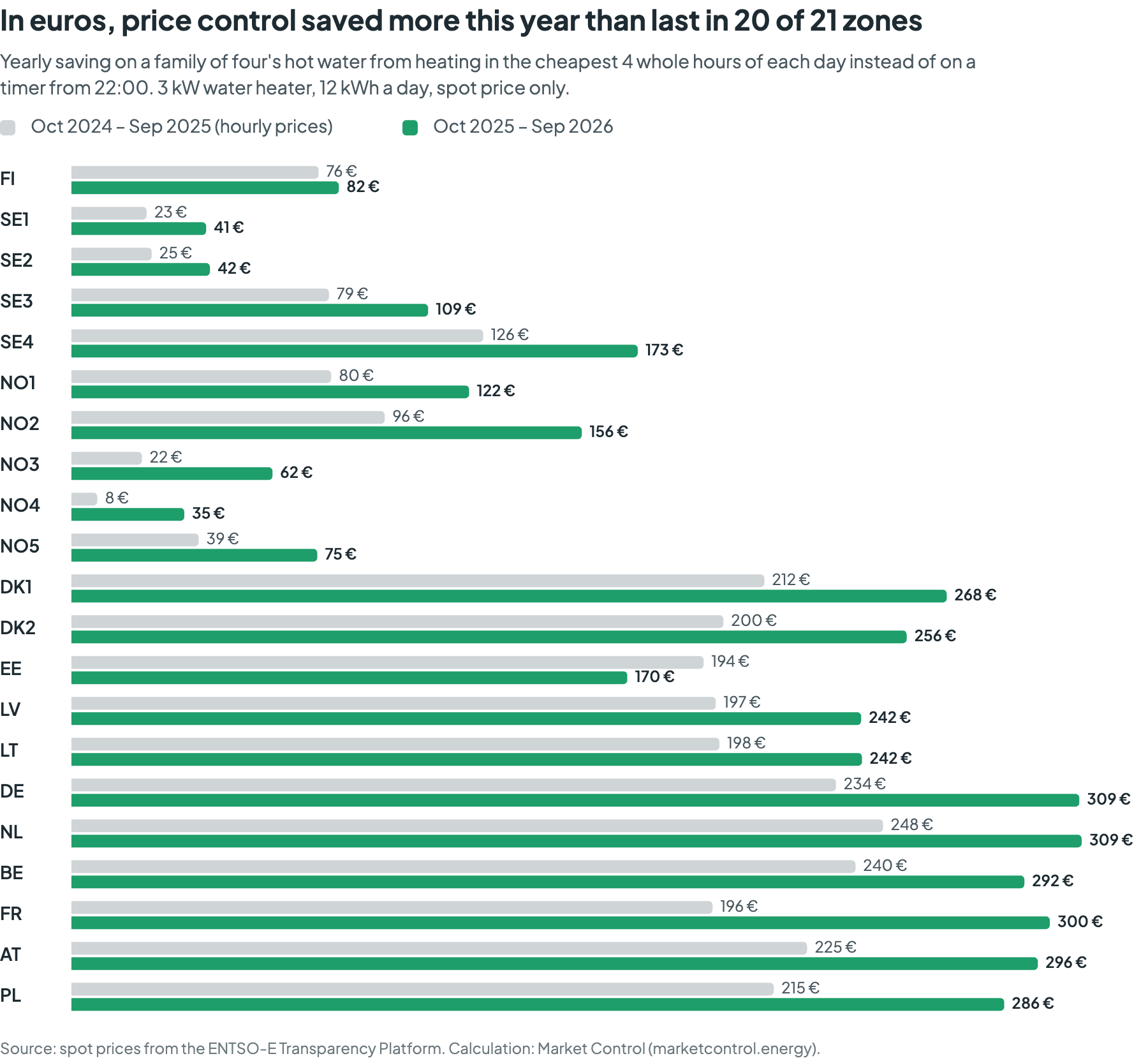
Not in euros, but in the Nordic and Baltic countries it was worth more as a share. We ran the same calculation on the last year of hourly prices, October 2024 to September 2025, with the heater on in the cheapest 4 whole hours of each day. Against the same night timer, price control saved 8–248 € a year then and 35–309 € in the first quarter-hour year, using whole hours in both. The saving in euros grew in 20 of the 21 zones (only Estonia's fell), because prices rose. As a share of the hot water's electricity cost, though, it fell in every Nordic and Baltic zone: in Finland it was 62 % in the hourly year and 40 % in the first quarter-hour year. In Central Europe the share held or grew, for example from 57 % to 61 % in Germany and from 58 % to 72 % in France.
| Zone | Average price 2024–25 | Average price 2025–26 | Price control vs timer 2024–25 | Price control vs timer 2025–26 | Winter daily spread 2024–25 | Winter daily spread 2025–26 |
|---|---|---|---|---|---|---|
| FI | 4.0 c | 5.6 c | 76 € (62 %) | 82 € (40 %) | 9.2 c | 8.0 c |
| SE1 | 1.4 c | 4.0 c | 23 € (53 %) | 41 € (30 %) | 2.5 c | 4.3 c |
| SE2 | 1.4 c | 4.0 c | 25 € (57 %) | 42 € (30 %) | 2.6 c | 4.4 c |
| SE3 | 4.3 c | 6.7 c | 79 € (55 %) | 109 € (41 %) | 8.5 c | 7.7 c |
| SE4 | 5.7 c | 8.2 c | 126 € (59 %) | 173 € (50 %) | 9.7 c | 9.3 c |
| NO1 | 5.3 c | 9.5 c | 80 € (37 %) | 122 € (29 %) | 5.7 c | 5.0 c |
| NO2 | 6.1 c | 9.8 c | 96 € (37 %) | 156 € (35 %) | 6.2 c | 4.8 c |
| NO3 | 1.5 c | 7.3 c | 22 € (41 %) | 62 € (20 %) | 2.7 c | 4.0 c |
| NO4 | 0.6 c | 3.1 c | 8 € (38 %) | 35 € (31 %) | 0.9 c | 4.1 c |
| NO5 | 4.1 c | 9.4 c | 39 € (24 %) | 75 € (19 %) | 4.5 c | 4.0 c |
| DK1 | 8.2 c | 10.1 c | 212 € (58 %) | 268 € (56 %) | 11.0 c | 8.5 c |
| DK2 | 8.3 c | 10.3 c | 200 € (55 %) | 256 € (54 %) | 11.5 c | 10.2 c |
| EE | 8.0 c | 8.2 c | 194 € (62 %) | 170 € (53 %) | 16.6 c | 16.1 c |
| LV | 8.3 c | 9.8 c | 197 € (60 %) | 242 € (56 %) | 16.3 c | 16.4 c |
| LT | 8.3 c | 9.9 c | 198 € (61 %) | 242 € (56 %) | 16.3 c | 16.4 c |
| DE | 9.2 c | 10.4 c | 234 € (57 %) | 309 € (61 %) | 11.4 c | 9.2 c |
| NL | 9.1 c | 10.3 c | 248 € (60 %) | 309 € (61 %) | 11.7 c | 8.8 c |
| BE | 8.6 c | 10.1 c | 240 € (59 %) | 292 € (59 %) | 9.8 c | 8.0 c |
| FR | 6.7 c | 7.7 c | 196 € (58 %) | 300 € (72 %) | 9.1 c | 8.2 c |
| AT | 9.9 c | 12.0 c | 225 € (51 %) | 296 € (53 %) | 11.1 c | 9.2 c |
| PL | 10.3 c | 11.7 c | 215 € (50 %) | 286 € (54 %) | 12.3 c | 11.7 c |
Each year runs from October to September. Here price control picks the cheapest 4 whole hours in both years, so the quarter-hours play no part. "Winter daily spread" is the average gap between the day's cheapest and dearest hour from October to March. The percentage is the saving as a share of the hot water's spot-price cost on the night timer. Cents per kWh, spot price only.
From one year to the next, the saving changed by between 23 € less and 103 € more, depending on the zone. That change is far larger than the 2–13 € the quarter-hours added. Prices were higher in every zone, and most of the extra saving came in summer: in Germany, the April–September saving grew from 177 € to 256 €, as midday solar power pushed prices well below the night.
Last winter was flatter than the one before in much of Europe. From October 2025 to March 2026, the average gap between the day's cheapest and dearest hour was 13 % smaller than a year earlier in Finland, 20 % smaller in Germany and 25 % smaller in the Netherlands. The winter saving fell slightly in Germany (52 € against 57 €) and held in Finland (35 € against 33 €). The northern price zones of Sweden and Norway went the other way: their prices were almost flat in the winter of 2024–25 and moved more the following winter.
How much does price control actually save?
- Price control pays as a rule. Even a fairly small load, just heating a family's hot water, saved 38–316 € a year (Finland 88 €, or 43 % of the hot water's spot-price cost) against a night timer. It takes a spot-price contract: on a fixed-price contract, control saves nothing.
- Small loads do not matter, large ones do. Shifting a dishwasher or a few lamps saves cents. With storage electric heating, common in Finland, the saving can be substantial. By our estimate, a house whose heating takes 15,000 kWh a year would have saved about 250 € in Finland, a quarter of the heating electricity's spot cost, by charging the store in the cheapest quarter-hours of the day instead of on night-rate electricity from 22:00. Kept to 22:00–07:00 for a night-time grid tariff, the saving would have been about 170 €. With direct electric heating, the choice of quarter-hour can matter too; for other loads it matters less.
- What matters more is choosing the length of the run. The load decides how long a device should stay on at a time. EV charging, for example, is better scheduled as one continuous block, say two hours, than split into quarter-hours. Splitting it gains only cents, and every interruption is a chance that the car does not resume charging. For hot water, one continuous 4-hour block cost only 3–12 € a year more than the scattered cheapest quarter-hours. The control app has to support that.
- Quarter-hour precision is a small extra. For hot water it added 2–13 € a year on top of hourly control, or 1–6 %, for storage heating about 30 €. If your meter only records hours, each hour's consumption is split evenly into quarters for billing, and quarter-hour control changes nothing on the bill.
- Summer counts in Central Europe. There most of the saving comes from April to September, when solar power makes midday cheaper than the night: in Germany 256 € of the year's 309 € with whole hours. A night timer misses the midday dip entirely. In Finland the halves are closer, 47 € in summer and 35 € in winter.
- VAT does not change the picture. Every figure here is the spot price only. VAT scales the differences up by its rate, for example by 25.5 % in Finland. Flat grid tariffs and margins add the same amount to every option and cancel out of the savings. Time-of-use grid tariffs are not included. They are usually cheaper at night, which narrows the gap between a night timer and price control.
Method
- Prices: spot prices for each zone, that is the day-ahead market's quarter-hour prices (hourly prices in the previous year), from the ENTSO-E Transparency Platform. Where ENTSO-E also publishes a second auction for the same zone (Germany, Austria and Denmark), we used the coupled European day-ahead price. Spot price only: no VAT, taxes, grid tariffs or retailer margin. All zones in euros.
- Checks: every day's average, lowest and highest price matched the daily figures Nord Pool publishes, in every zone and on every day compared. For Estonia, Finland, Latvia and Lithuania, every hour and quarter-hour also matched the Nord Pool prices published by Elering, the Estonian transmission system operator, and on the days our own price history covers, every quarter-hour matched it too, all to within 0.01 €/MWh.
- Period: 1 October 2025 to 30 September 2026 in each zone's local time.
- Hourly average: the mean of the four quarter-hours of each local hour. Daylight-saving days have 23 or 25 hours.
- Hot water: a 3 kW water heater running 16 quarter-hours (12 kWh) a day. That is about what a family of four uses. In Finnish detached houses each person uses about 111 litres of water a day, 35–40 % of it hot (Motiva), and heating a cubic metre of water by 50 °C takes 58 kWh (Motiva). For four people that is 9–10 kWh a day, and the tank loses another 2–3 kWh as heat.
- Storage electric heating (estimate): a house whose heating takes 15,000 kWh a year, with a store charged at 15 kW. The heating demand is spread over the days by Jyväskylä's actual daily mean temperatures, using heating degree days (Finnish Meteorological Institute). The baseline is night-rate electricity that starts charging at 22:00. For houses whose heating takes 10,000–20,000 kWh, the saving was 185–310 € a year.
- Whole bill (Finland): spot price with 25.5 % VAT, electricity tax and security-of-supply fee of 2.253 c/kWh plus VAT, a grid tariff of 4–6 c/kWh and a retailer margin of 0.5 c/kWh. Grid fees, taxes and margin are the same in every option, so they shrink the saving as a share but not in euros.
- Zones: the 21 zones of the Nordic and Baltic countries, Germany, the Netherlands, Belgium, France, Austria and Poland, all of which publish quarter-hour prices. Southern and south-eastern Europe (Spain, Italy, Czechia and others) is not included.
Doing it automatically
Following the cheapest hours takes no effort. A Shelly relay and the Market Control for Shelly app control a water heater, storage or direct electric heating, EV charging and other loads by the spot price. For each device you choose how many of the day's cheapest periods it runs and how long they are: 15 or 30 minutes, or 1, 2, 4, 6 or 8 hours at a time. You can also add a price limit or rules on the outside temperature.
A Shelly relay costs a few tens of euros, and the app is free for one Shelly device; Premium unlocks any number of devices. Most electricians already know how to install a Shelly. This guide shows the installation for a water heater; the electrical work belongs to a qualified electrician.